
- Home
- About Us
- Sheriff's Message
- Mission
- Inside Your Sheriff's Office
- Get to Know the MCSO
- Citizens on Patrol - Supporting the Sheriff's Office through Volunteerism
- History Highlight: A Look Back at the Mesa County Sheriff's Office Bike Patrol Team
- Reducing Reincarceration One Inmate Transition at a Time
- The Truth About Cryptocurrency - Part 1
- The Truth About Cryptocurrency - Part 2
- The Truth About Cryptocurrency - Part 3
- When Emergency Management Meets Emergency Medicine
- History
- Sheriffs of Mesa County
- Wall of Honor


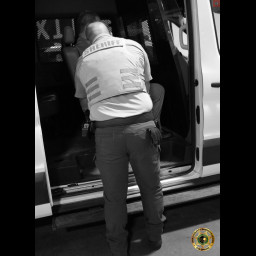

Safety For All While Transporting Inmates
Transporting inmates from the Mesa County Detention Facility (MCDF) to a community health, medical, or mental health appointment isn’t something made public very often, if at all. It’s only done when such an appointment can’t be conducted inside the MCDF. Moving inmates around outside the facility is closely guarded and monitored for the safety and security of all. Historically, inmate transports have been conducted by a mix of Detention and Courthouse deputies and contracted armed security guards.
Until recently.
Every few years, leadership rotates or promotes mid-level managers within the agency, bringing fresh perspectives, new insights, and innovative ideas to each unit's responsibilities. This infusion of new people creates inquisitive conversations, thoughtful discussions, challenges existing processes, and can lead to greater efficiencies along with renewed enthusiasm among team members. The result is a continuous cycle of growth, innovation, and organizational improvement.
A recent example of a rotation in leadership transitions led to the creation of the Transport Unit.
The Court Services Unit most recently came under the direct leadership of Lieutenant David “Bucky” Holdren. Understanding the varied duties and responsibilities of the Court Services sergeant, as well as the span of control and complexities of the assignment, caught his attention. Lt. Holdren, working with the Court Services sergeant, Sgt. Rob Beagley, and a new sergeant position, brought Sgt. Craig Bowen into the plan to create a dedicated Transport Unit. All of this had to be completed without burdening the budget and with the resources already on hand. A work group with Lt. Holdren reached out to Arapahoe and Jefferson County Sheriff’s Offices, who have dedicated transport units to understand best practices, pitfalls, and efficiencies.
Now with two sergeants dividing the complex duties, it mitigates some of the heightened supervisory complexities within the unit. The official breakdown of full-time employee (FTE) positions was that the Support Services Division provided the sergeant, and the Detentions Division provided two additional deputies to specialize in inmate transport. The two detention FTE positions had gone unfilled. The Court Services Unit now exists as two closely related units - Court Security and Inmate Transport.
The Court Services Unit secures the Justice Center, which includes screening in excess of 12,000 citizens monthly upon entry to the building, securing judges and 21st Judicial District personnel, the elected District Attorney and his office staff, as well as jurors, victims, witnesses, families, and the public at large within courtrooms throughout the building. It also includes maintaining care, custody, safety, and control of inmates in the Justice Center who are making court appearances.
Inmate transports typically have 3-6 medical visits a week in our local community. An average of 15 long-haul transports a month can be over the Continental Divide and back, or out of state. Large-scale or high-profile trials in the Justice Center can take extra manpower, pulling deputies who might typically transport inmates. It causes a strain on a unit for a task that is mandated to remain in compliance for the health and safety of inmates in the Detention Facility. Transporting inmates is also high-risk, regardless of the reason for the excursion outside the Facility. Taking an inmate out into the community adds a number of opportunities for challenges to occur.
Sgt. Beagley, has been molding a mentoring opportunity to cross-train weapon-certified detention deputies with court security duties. Expanding the capabilities and experience of detention deputies while also creating a back-up pool of staff should the Justice Center need a sudden boost in security presence. This kind of cross-training also shifts agency culture, breaking down silo walls between teams and units across the agency.
Sgt. Bowen, tapped to develop and lead this new Transport Unit is widely known as a problem-solver, go-to leader, with a can-do attitude. He conducted interviews of deputies interested in being part of the new Transport Unit and ultimately picked two weapon-certified deputies - Maximus Wiltse and Ryan Cassidy. Both describe themselves as outside-the-box thinkers, problem solvers, and confident decision makers. Skills that Sgt. Bowen and Lt. Holdren were seeking specifically in these new roles. Both have collateral duties that include SORT - Special Operations Response Team and CRT - Critical Response Team, for responding to incidents inside the detention facility.
Not every day will be the same for the Transport Unit. And not every day will have a transport scheduled.
“If I’m not on a transport one day, then I’m their huckleberry for the day,” Sgt. Bowen said.
Inmate transports are the priority of this new unit, but they are versatile enough to backfill, lend a hand, or work a post. He went on to explain that he and the two deputies who are now the entirety of the new Transport Unit have all been previously assigned to the detention facility and thus can easily pivot between highest priority tasks in the jail or Justice Center.
Joining the Transport Unit means a minimal 1 year rotational position with deep opportunities to grow in function, knowledge, experience, and more. Some deputies thrive on the routine of jail functionality, but others really seek unique opportunities to experience the opposite. Having flexibility and thriving in high-stress situations were musts on the skill set list of requirements when considering what the ideal deputy would be for crafting these new agency roles and units.
“It’s been a huge amount of pressure for me,” Sgt. Bowen said. “I’ve hit the ground running and haven’t looked back. I’m always focused on doing better, being safer, and more efficient.”
“Having this unit will expand safety more than ever before,” Lt. Holdren said. “For the community, deputies, and inmates.”
“There is always a chance of being called in for critical incidents,” Dep. Cassidy says about his detention team position. “Even day-to-day operations in the jail are different. It’s the same schedule, but anything can happen.”
With Sgt. Bowen, Dep. Cassidy and Dep. Wiltse are laser-focused on transporting inmates and the best practices around that. They’ve already identified some potentially unnecessary mental health transports of inmates that could possibly be resolved by virtual appointments and eliminating a transport outside the facility. Over time, this team's operations will surely become more efficient and structured - dialed in.
They may be small in numbers, but they are mighty in the work they are doing to keep both our community and inmates safe, while providing medical-necessity appointments out in the community.
To view additional photos related to this write-up, visit: https://www.facebook.com/Mesacountysheriffsoffice
Created Jul 10, 2026 @ 4:01 PM | Updated Jul 11, 2026 @ 3:00 PM

