Window Tint Laws
WEST MANCHESTER TOWNSHIP POLICE DEPARTMENT
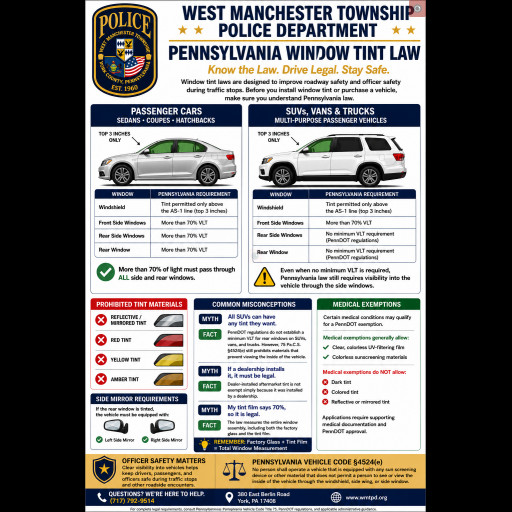
PENNSYLVANIA WINDOW TINT LAW
Public Information & Education Guide
Before you install window tint or purchase a vehicle with tinted windows, make sure you understand Pennsylvania law.
Window tint laws are intended to improve roadway safety, driver visibility, and officer safety during traffic stops. Failure to comply with Pennsylvania's window tint requirements may result in enforcement action and the need to remove unlawful tint.
WHAT IS VLT?
VLT (Visible Light Transmission) is the amount of light that passes through a vehicle window.
Pennsylvania law measures the entire window, including:
- Factory-installed glass
- Any aftermarket tint film
Important: A tint film labeled "70%" may still result in an illegal window if the combined glass and film do not allow more than 70% of light to pass through.
PASSENGER CARS
Sedans • Coupes • Hatchbacks
| Window | Pennsylvania Requirement |
|---|---|
| Windshield | Tint permitted only above the AS-1 line (top 3 inches) |
| Front Side Windows | More than 70% VLT |
| Rear Side Windows | More than 70% VLT |
| Rear Window | More than 70% VLT |
For most passenger cars, all windows other than the top portion of the windshield must allow more than 70% of light to pass through.
SUVs, VANS & TRUCKS
Multi-Purpose Passenger Vehicles
| Window | Pennsylvania Requirement |
| Windshield | Tint permitted only above the AS-1 line (top 3 inches) |
| Front Side Windows | More than 70% VLT |
| Rear Side Windows | No minimum VLT established by PennDOT regulations |
| Rear Window | No minimum VLT established by PennDOT regulations |
IMPORTANT
While PennDOT regulations do not establish a minimum VLT requirement for rear side windows and rear windows on SUVs, vans, and trucks, Pennsylvania Vehicle Code still contains visibility requirements that may apply.
PROHIBITED TINT MATERIALS
Pennsylvania law prohibits:
❌ Reflective or mirrored tint
❌ Red tint
❌ Yellow tint
❌ Amber tint
SIDE MIRROR REQUIREMENTS
If the rear window of a vehicle is tinted, the vehicle must be equipped with:
✔ Left outside rearview mirror
✔ Right outside rearview mirror
MEDICAL EXEMPTIONS
Certain individuals with qualifying medical conditions may apply to PennDOT for a medical exemption.
Important Facts
Medical exemptions generally allow:
✔ Clear, colorless UV-filtering film
✔ Colorless sunscreening materials
Medical exemptions do NOT authorize:
❌ Dark tint
❌ Colored tint
❌ Reflective tint
Applications require supporting medical documentation and PennDOT approval.
COMMON MISCONCEPTIONS
MYTH:
"All SUVs can have any tint they want."
FACT:
PennDOT regulations do not establish a minimum VLT requirement for rear side windows and rear windows on trucks and multi-purpose passenger vehicles. However, Pennsylvania Vehicle Code §4524(e) still prohibits materials that prevent a person from viewing the inside of the vehicle through the windshield, side wing, or side window.
MYTH:
"If a dealership installs the tint, it must be legal."
FACT:
Dealer-installed aftermarket tint is not exempt simply because it was installed by a dealership. Pennsylvania law distinguishes between manufacturer-produced glazing and aftermarket tint materials applied after manufacture.
MYTH:
"My tint film says 70%, so it is legal."
FACT:
The law measures the entire window assembly, the window plus the added film—not just the tint film.
PENNSYLVANIA VEHICLE CODE §4524(e)
Pennsylvania law prohibits operating a vehicle with a sun screening device or other material that does not permit a person to see or view the inside of the vehicle through the windshield, side wing, or side window.
Visibility into a vehicle is an important officer-safety consideration during traffic stops and other roadside encounters.
BEFORE YOU TINT
✓ Verify the installer understands Pennsylvania law.
✓ Ask for documentation showing the measured VLT.
✓ Remember that factory glass affects the final VLT reading.
✓ Keep all receipts and installation paperwork.
✓ When in doubt, ask questions before installation.
QUESTIONS?
West Manchester Township Police Department
380 East Berlin Road
York, Pennsylvania 17408
(717) 792-9514
This handout is provided for public education purposes and is not intended as legal advice. For complete legal requirements, consult Pennsylvania Vehicle Code Title 75, PennDOT regulations, and applicable administrative guidance.