


Safety Series: Heat Safety and Prevention
Welcome to a new educational series! Safety is important to emphasize when it comes to our communication online and with our community. It will be our duty to put out informational flyers that can be utilized within our community, such as general, vehicle, and crime safety.
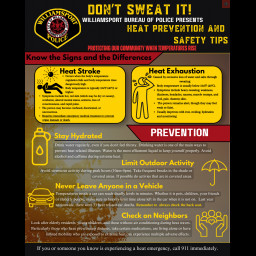
This Sunday, we are covering a topic that will apply all summer long. With the Pennsylvania weather, it often goes in and out of heat, sometimes drastically. During periods of extreme heat, check on elderly residents, young children, people without air conditioning, and those with medical conditions, limited mobility, or who live alone, as they are at greater risk for heat-related illness. Stay hydrated, avoid strenuous outdoor activities during the hottest part of the day (10 a.m.–4 p.m.), and take frequent breaks in shaded or covered areas. Never leave children, pets, or vulnerable adults unattended in a vehicle, as temperatures inside a car can become deadly within minutes. Always check the back seat before leaving your vehicle and take steps to keep yourself and others safe during hot weather.
Know the difference between heat exhaustion and heat stroke: heat exhaustion is caused by excessive sweating and fluid loss, with symptoms such as weakness, dizziness, headache, nausea, and clammy skin, and usually improves with rest, cooling, and hydration. Heat stroke is a medical emergency that occurs when the body's temperature rises to 104°F or higher and can cause confusion, loss of consciousness, seizures, and hot, red skin. Immediate medical attention is required to prevent serious injury or death.
It is important to be able to identify common heat illnesses so you don't sweat it if dealing with one during your summer fun. If you or someone you know is experiencing a heat emergency, call 911 immediately.
